
Adapting to Acceleration
Lessons from Alvin Toffler’s 'Future Shock' in the Modern Era

Waking up at the crack of dawn yesterday (which isn’t very early these days), I was listening to the New York Times podcast “The Daily” discuss an interesting phenomenon in American culture — “The Bad Vibes Around A Good Economy:” Why, if the economy is doing so well, are Americans feeling so bad about it?
After laying out why the American economy, “by many measures, is doing better than it has done in years,” the intrepid researchers from the New York Times had multiple explanations for why Americans are experiencing a deep sense of unease and discomfort in their daily lives. These explanations included sticker shock to rising prices of basic goods like gas and groceries, part of the inflation that the hosts lauded as a “perfectly healthy” capitalistic phenomenon necessary for a growing modern economy. They talk about the rapid increases in real estate prices, and the seemingly insurmountable obstacles preventing young people from buying their first homes. Finally, they outline the negative influence of social media ecosystems, especially those engineered by American competitors like the Chinese information machine known as TikTok, and that those platforms prioritize algorithms that are biased towards bad news about the American economy.
By the end of the episode, something ineffably unaddressed still hung in the air, despite their rigorous analysis. The hosts conceded that “something else may be pulling confidence down;” a deep sense of uneasiness, anxiety, and depression is plaguing the generation that should be rigorously striding into the twenty-first century, bearing the future of our species on our powerful and unwavering shoulders. I found these answers from the New York Times were insufficient — they are only symptoms of a global economy that bloats with debt and is increasingly reliant on carbon energy expenditure at higher and higher costs.
We have been through times like this before — so why do Americans feel so bad about the present while being so anxious about the future?
A few months ago I finished reading Alvin Toffler’s seminal work, “Future Shock.” It is a book that, although written in the 1970s, continues to resonate profoundly in our contemporary world. Toffler, a visionary and a scholar, foresaw the psychological and societal impacts of the rapid technological and social changes that we are experiencing today. The book is a wild ride, with Toffler predicting a fair amount of ridiculous changes to the future culture of our species, yet the core concept shined a light on many of the foundational struggles that we face today as a global, technologically advanced civilization.
The core concept behind “Future Shock” is a detailed and harrowing description of a society overwhelmed by the pace of change. We all know what culture shock means — a stressful period of transitioning from one culture to another. The stress occurs from a lack of context and essential information about the culture you are currently experiencing. You are trying to adapt and learn while actively existing within the new paradigm.
“We are not being asked to adopt a new culture, rather a blinding succession of temporary cultures.”
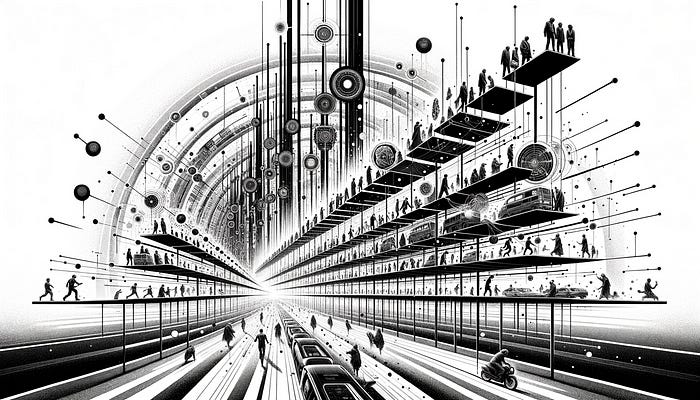
Toffler described Future Shock as a form of continuous, escalating culture shocks, in which we constantly attempt to adapt to a steadily accelerating rate of change. He outlined the characteristics of a technologically driven, post-industrial society; one in which traditional structures and values would be relentlessly challenged by the tides of technological advancement and societal shifts. Toffler described a future where the only constant is change itself, in which every daily practice and every human skill set is steadily made obsolete by a rapidly changing techno-socio-economic landscape. From Toffler’s perspective, this constant change leads to a state of perceptual adaptation and extreme, long-term psychological stress.
One interesting passage painted a picture of the world that surrounded him in the 1970s:
“The assertion that the world has “gone crazy,”
The graffiti slogan that “reality is a crutch,”
The interest in hallucinogenic drugs,
The enthusiasm for astrology and the occult,
The search for truth and sensation, ecstasy and peak experience,
The swing toward extreme subjectivism,
The attacks on science,
The snowballing belief that reason has failed man,
Reflect the everyday experiences of masses of ordinary people who find they can no longer cope rationally with change.
These are rooted in the uncontrolled, nonselective nature of our lunge into the future. They lie in our failure to direct, consciously and imaginatively, our advance towards super industrialism.”
In the 1970s, the phenomena Toffler lists in this passage were not merely cultural trends but symptoms of a society experiencing “future shock.” Today, we see dramatically similar trends, as people grapple with the relentless advancement of technology and the erosion of traditional societal anchors.
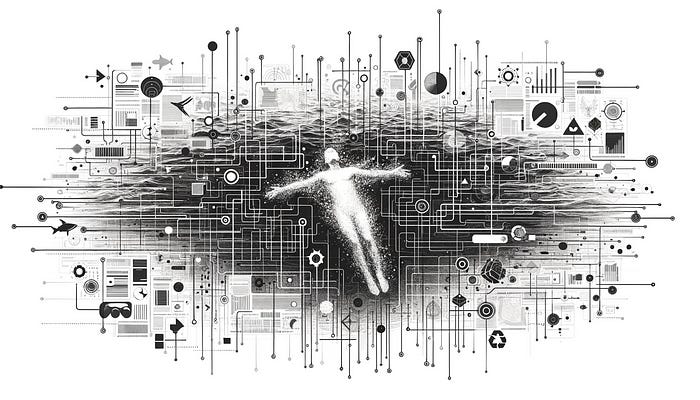
It is a phenomenon that we are all feeling. It is like the sensation of drowning. Everything around us is changing faster than we can even develop the shared language to discuss it properly, let alone contextualize that change within a holistic understanding of how the world works. The more confused, overstimulated, and psychologically stressed we become, the more we take refuge in practices that simplify reality to an understandable narrative. That’s why we are so addicted to political slogans, cultural memes, oversimplified perspectives, quaint fabricated worlds, and solvable conflicts engineered for our pleasure in the media we consume. Most of these behaviors are simply defensive “sensory shielding” to mitigate daily future shock symptoms.
Toffler’s book was groundbreaking in its analysis of “information overload” and the transient nature of modern society. He foresaw, even from the pre-internet 1970s, a world where the lifespan of ideas, relationships, cultural norms, and material objects would be drastically shortened, giving rise to a “throw-away” society. He warned of a world where we would no longer need to adapt to gradual cultural change, but rather to a rapid succession of temporary cultures. This concept may ring true in our era of rapid technological advancements and shifting social norms. To cope with this sensory stress, many resort to “defensive sensory shielding,” using technology and social media as buffers against the onslaught of change. This behavior leads to increases in technological addictions and a retreat from face-to-face interactions. More and more, we seek refuge in the familiar confines of carefully manufactured, familiar digital worlds.
Toffler’s work was not without limitations; He made some wild and even hilarious predictions about how our culture would evolve. He also did not fully anticipate the extent to which AI and machine learning would revolutionize the creative and intellectual spheres:
“In the technological systems of tomorrow, fast fluid and self-regulating machines will deal with the flow of physical materials, men with the flow of information and insight. Machines will increasingly perform routine tasks, and men perform the intellectual and creative tasks.”
Today, AI is not ONLY supplementing human effort in routine tasks but is also making significant inroads into areas traditionally considered the domain of human creativity. We all thought AI would be driving trucks, sorting boxes, and making our burritos — while this will undoubtedly be true (With Goldman Sachs predicting that up to 300 million full-time jobs — as much as 18% of the global workforce — could be lost around the world as a result of the automation from ChatGPT and other AI tools), we were shocked to discover that the first jobs lost to AI bots were in the spaces of creative writing and drawing fantasy artwork. As more and more intellectual tasks are replaced by AI, the division of labor between man and machine will become more blurred than ever. Our perception of purpose and self-realization will only become more murky in a hurricane of technological advancement.
Ok, so we are struggling to keep up. How do we fix this?
The bottom line is uncomfortable to hear: In our present civilizational systems of living, the trends of rapid technological advancement and cultural change will never slow down. Regardless of culture, if our practices of carbon energy consumption continue on the present course, our civilization will inevitably collapse under its bloat far before we feel the dramatic effects of existential risk factors like climate change. In this scenario, we would simply experience escalating forms of cultural madness and despair until the entire system implodes, sending our descendants into a civilizational reversion (or simplification, as gently phrased by Nate Higgins in the linked explanation above).
“Millions of human beings will find themselves increasingly disoriented, progressively incompetent to deal rationally with their environments. The malaise, mass neurosis, irrationality, and free-floating violence already apparent in contemporary life are merely a foretaste of what may lie ahead unless we come to understand and treat this disease. Future shock is a time phenomenon, a product of the greatly accelerated rate of change in society. It arises from the superimposition of a new culture on an old one. It is culture shock in one’s own society.”
In order to buy more time, we will need to transition our energy consumption to a dramatically more sustainable model. No, I do not mean harvesting the power of wind or the sun — anything less than scalable fusion energy would be insufficient. With more time under our flawed system comes the potential to course correct. According to Toffler, an essential component of this course correction will be a reform of our educational systems.
To mitigate future shock, Toffler emphasized the need to reform our education systems away from specific, skill-based educational models, and towards generalized models that teach psychological adaptability, systems thinking, and rapid response programming to meet the needs of present-day technology and economy. He argued for a shift from imparting knowledge of the past to preparing individuals for an uncertain and rapidly changing future. If we learned anything from the recent COVID-19 pandemic, we saw in stark relief the shortcomings of the traditional, standardized education model when it was shoehorned into a virtual setting. It showed us the necessity of a more adaptable and flexible approach to learning, one that can cater to diverse intellectual needs and escalating changes in our techno-socio-economic landscape.
“To survive, to avert what we have termed future shock, the individual must become infinitely more adaptable and capable than ever before. We must search out totally new ways to anchor ourselves, for all the old roots — religion, nation, community, family, or profession — are now shaking under the hurricane impact of the accelerative thrust. It is no longer resources that limit decisions, it is the decision that makes the resources.”
It is the one, enduring lesson from Toffler’s “Future Shock:” Adaptability is the key to the survival of our species. This shouldn’t be a surprise — adaptability has brought every living species on our planet to the present moment. The concept of future shock itself is a form of adaptability spinning out of control. Our education systems must pivot from imparting specific skill sets, which rapidly become obsolete, to fostering adaptability, critical systems thinking, and a capacity for continuous learning. As Toffler aptly stated, “As the rate of change in the system exceeds the rate of developing new responses to change, control over the system is lost.” To maintain control, to survive, and to thrive, we must gain the ability to navigate the rapids of change. We must become a new generation of rapid-response learners, ever ready to adapt, evolve, and embrace an unknown future delivered to our waking eyes.